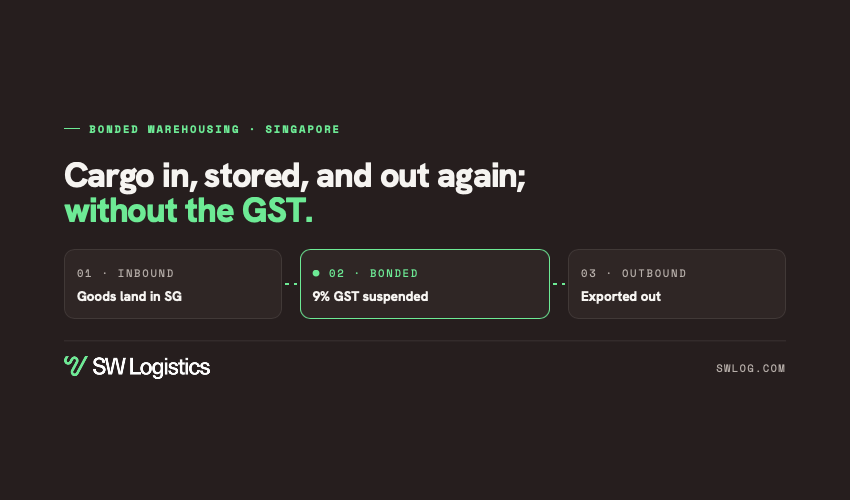
If you import goods into Singapore and later re-export them out of the country, you get to skip out on GST, only if you use bonded warehousing.
Bonded warehousing lets you hold imported goods under Customs supervision and settle those charges only when the goods are released for local use.
This guide explains how it works in Singapore, which scheme applies to your cargo, and what to look for in a provider.
What is a bonded warehouse?
A bonded warehouse is a secure storage facility, licensed by Singapore Customs, where imported goods can be stored with duty and/or GST suspended. Your goods are still physically in Singapore, but they are treated as not yet released into the local market. Tax becomes payable only when they leave the warehouse for local use or consumption.
"Bonded warehouse" is a common term, but Singapore Customs actually runs two distinct schemes. Which one applies depends on your goods.
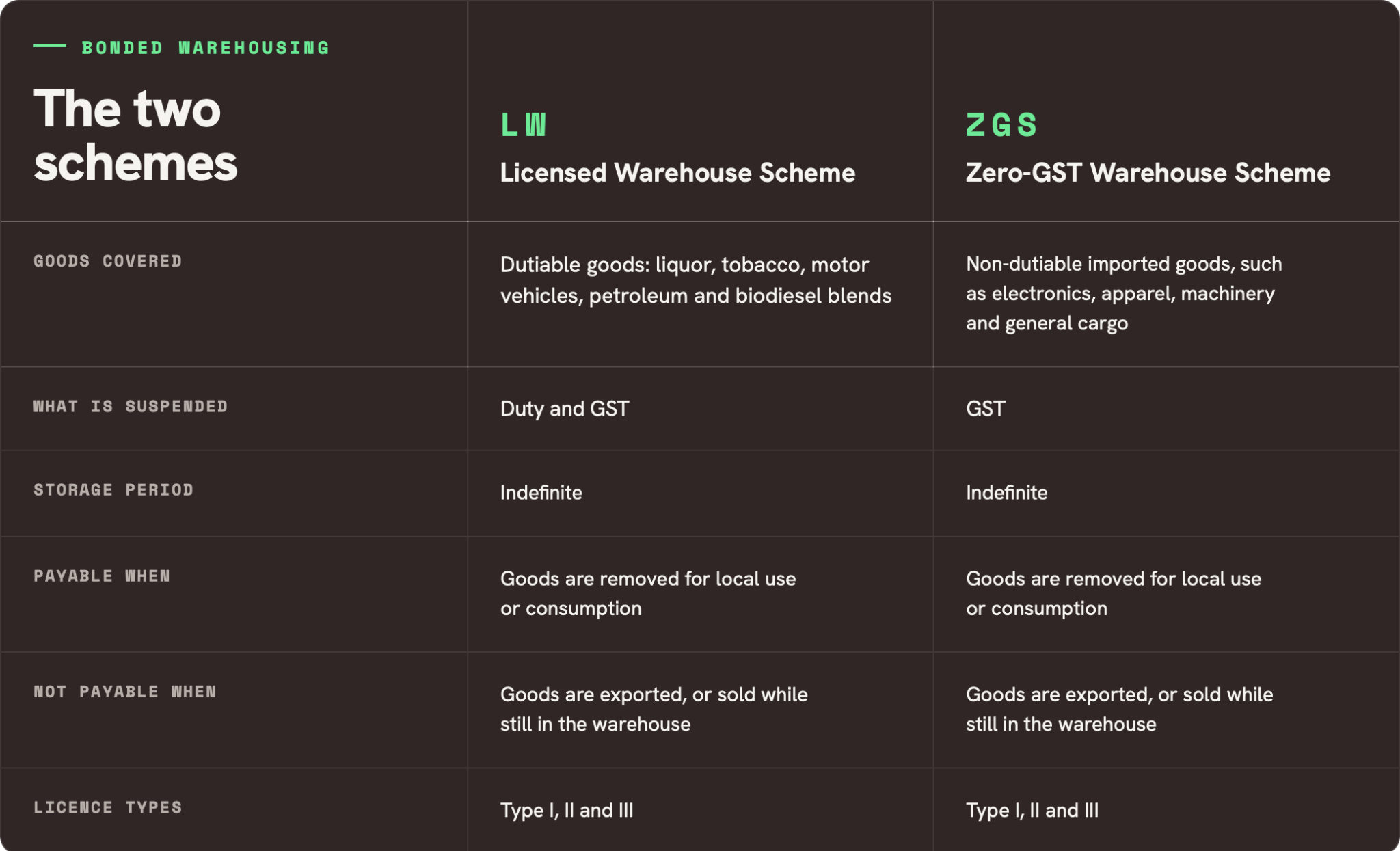
Both schemes have three licence types. The level of facilitation, and the standard of record-keeping and internal controls required, rises from Type I to Type III. Each type is linked to a band under Customs' TradeFIRST assessment.
How it works, step by step
- Goods arrive and are declared. A Customs permit is submitted through TradeNet for the movement of goods into the licensed premises.
- Goods are stored and tracked. The goods sit in a designated licensed area with security controls, and accurate stock records are kept at all times.
- Goods are handled as needed. Depending on the licence conditions, you may be able to arrange services such as relabelling or repacking. Do note that goods cannot be tampered with as they are kept under strict supervision. Always confirm with your provider first the extent of involvement allowed when it comes to bonded goods.
At SW Logistics, we provide up to 21,000 sq feet of space for bonded warehousing where our staff oversees all handling in order to ensure your cargo is handled safely.
- Goods are released. If they go into the local market, duty (where applicable) and GST are paid at that point. If they are exported, or supplied while still in the warehouse, those charges are not payable.
What it means for your cash flow
Say you import $500,000 worth of electronics and the local GST applies at 9%. Normally that is $45,000 due at import. Under a Zero-GST warehouse, you pay it only when stock is released locally, so you can release stock in stages as customers order.
- You have the optionality of paying $45,000 thanks to bonded warehousing.
For example, if you are selling $500,000 worth of goods but customers only purchase up to $250,000. The remaining $250,000 worth of goods can be reexported out and you only have to pay on the amount of goods released for local consumption.
- The main advantage of bonded warehousing is flexibility. Goods held under bond can sit in Singapore without being committed to a market, so you decide where they go only when demand tells you.
If orders surge in Malaysia or Indonesia, you release stock there. If a market softens or supply tightens, you hold, redirect or re-export without having paid import GST on goods that never entered local consumption. That lets you respond faster to shifts in demand and supply across the region, using one central stock position instead of several committed ones.
The financial benefit follows from this. GST-registered businesses can usually claim back import GST, subject to conditions, so for many importers the gain is in timing rather than a permanent saving. It is still worth having, especially for high-value stock, slow-moving lines, or goods that are eventually re-exported and never attract GST at all.
Who benefits most
- Regional traders using Singapore as a distribution hub
- Businesses with seasonal or unpredictable demand
- Companies storing goods destined for re-export or transshipment
- Importers of vehicles, liquor or other dutiable goods that must be stored under an LW licence
Compliance is the trade-off
Suspended tax comes with responsibility. The licensee is accountable to Customs for the goods and for any duty and GST on stock that cannot be accounted for. In practice, that means:
- Accurate permits for every movement in and out
- Reliable, up-to-date inventory records
- Adequate physical security, with entrances and exits secured when there is no movement of goods
- Reporting any stock discrepancy to Customs by the next working day
- Separate approvals for controlled goods, such as dangerous goods, from the relevant authorities
- Customs approval before disposing of or destroying duty-suspended goods
Errors carry real penalties, including for incorrect declarations, so accurate HS codes and quantities matter.
Get your own licence, or use a 3PL?
To hold your own licence, a company must be GST-registered, hold a valid Customs Account, have a good compliance record, operate a secure storage-based facility, and pass a TradeFIRST assessment. Licence processing can take several months, and an annual fee applies.
For many importers, it is faster and more cost-effective to use a 3PL that already operates a licensed facility. You get the tax suspension without building the infrastructure, hiring a compliance team, or carrying the licence risk yourself.
How to choose a bonded warehouse partner
Look for the right licence for your goods, strong inventory visibility, proven security, experience with TradeNet permits, and flexibility on value-added services. Our companion article, Bonded Warehouse Checklist: 8 Questions to Ask Your 3PL, walks through each of these.
Bonded storage at SW Logistics
We operate a 21,000 sq ft bonded facility at Jurong Logistics Hub, fully licensed and backed by full WMS visibility from inbound to outbound. Our team can also support permits, pick and pack, distribution and transloading. Space is limited, so contact us early to check availability.
Contact our team about bonded storage
This article is for general guidance. Scheme rules and fees are set by Singapore Customs and may change, so please confirm current requirements before making decisions.